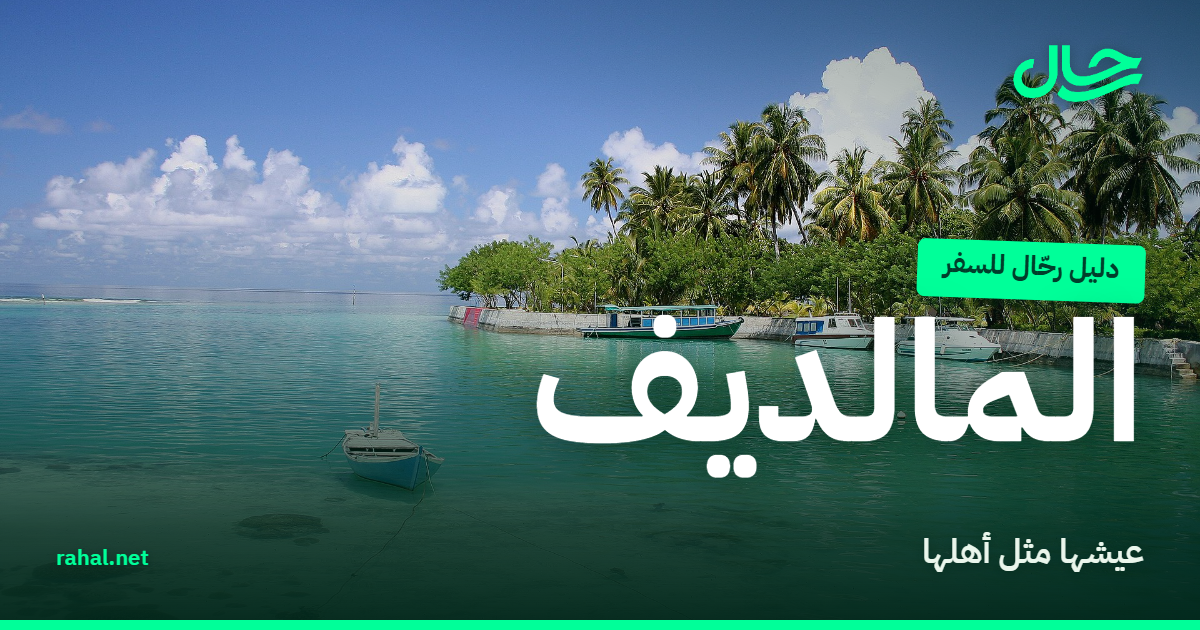
The Maldives Like a Local: Beyond the Overwater Bungalow
Most people picture the Maldives as one image: a hut over the water, a honeymoon couple, and a ten-thousand-dollar bill. But that's the resort's picture, not the country's. If you want to live the Maldives the way its people do, you need to know that behind the private resorts is a full Muslim nation, half a million people, living on small islands with schools, mosques, and cafés, whose whole life revolves around the sea, fish, and a Friday prayer that stops the entire island. And since the local islands opened their doors to visitors, you can now experience the same turquoise water from a guesthouse for fifty dollars instead of a thousand. For Iraqi travelers specifically, this is a destination tailor-made: a free visa on arrival, and a country that's halal from head to toe. In this guide from the Travel Like a Local series, we'll walk you through the real Maldives.
Who lives there?
The Maldives has around 520,000 people spread across roughly 190 inhabited islands out of 1,192 total, grouped into 26 atolls (coral island rings). The capital, Malé, is a phenomenon in itself: one of the most densely populated cities in the world, a small island packed with colorful buildings, narrow streets, and motorbikes, home to half the country's population between it and its suburbs.
Islam is the state religion, every citizen is constitutionally Muslim, mosques are the heart of every island, and Friday prayer effectively halts activity. The local language is Dhivehi, with its own beautiful and unusual script (resembling South Asian scripts), but English is widespread in the tourism sector and among younger people.
Maldivians are a seafaring people by nature: fishing is the ancestral trade, tuna is the backbone of both diet and economy, and every child learns to swim before they learn to ride a bike. They're a calm people, conservative on their local islands, and used to guests from all over the world.
How much does daily life cost?
Here we need to be doubly honest: first, because the Maldives imports almost everything, so prices run higher than its neighbors; and second, because pricing data is limited (few contributors on Numbeo), so take these as rough indicators (mid-2026):
- Monthly living costs for one person in Malé, excluding rent: around $750 to $800.
- A meal at a local restaurant in Malé: $5 to $8, higher at tourist restaurants.
- A guesthouse room on a local island like Maafushi: $50 to $90 a night, most including breakfast.
- A night at a resort: from $300 for something modest, climbing as high as your imagination for overwater villas.
Here's the key piece of information: the guesthouse law that allowed local islands to host tourists changed the equation entirely — you can now spend a full week in the Maldives (accommodation, food, and boat trips) for the price of two nights at a resort. Same sea, same colorful fish, just a different bill.
The local currency is the rufiyaa, but dollars are accepted throughout the tourism sector, and prices are often quoted in dollars to begin with.
How do people get around?
A country of islands means transport means boats. Locals move between islands on public ferries: slow but very cheap ($1 to $3 a ride), with limited schedules that usually don't run on Fridays, so plan around that. The faster alternative is speedboats, with more frequent schedules and prices from $20 to $30 for well-known routes like Malé to Maafushi.
Seaplanes are the remote-resort experience: expensive (hundreds of dollars) but the view of the atolls from above is indescribable, and the resort arranges it for its guests.
Inside Malé itself? Your feet are enough — the whole city is walkable in half an hour, and taxis exist with a fixed short-trip fare. The Sinamalé Bridge connects Malé to the airport and the new Hulhumalé suburb.
What do they eat… and when?
Maldivian cuisine is built on a sacred trio: tuna, coconut, and roshi (a thin flatbread similar to chapati). The national breakfast is mas huni: shredded tuna with grated coconut, onion, and lime, wrapped in roshi with a glass of tea — the start of every Maldivian's day.
Lunch and dinner revolve around garudhiya: a clear tuna broth poured over rice with lime and chili, closest to our own fish broth but lighter and clearer. Fresh grilled fish on the local islands is a daily meal, not a special occasion.
The best local habit is hedhika, meaning "small bites": fried tuna-and-coconut fritters (gulha and bajiya) eaten in the afternoon with tea at small cafés — their version of our afternoon tea-and-kleicha sit-down.
And news that puts your mind fully at ease: all food on the local islands is halal by constitutional law, and there's no alcohol or pork whatsoever outside the private resorts. Eat anywhere without asking a single question.
The unwritten rules
- Understand the difference between two worlds: the resort is a private island with its own open rules, while the local island is a conservative Muslim community. Dress and behavior shift completely between the two, and respecting that difference is the key to the whole trip.
- Dress is modest on local islands, for men and women, on the streets and in public spaces. Swimwear is only allowed on the designated "bikini beach" found on every local tourist island.
- Friday is the island's sacred day: the weekend is Friday and Saturday, and during Friday prayer time shops close, ferries stop, and the whole island goes quiet. Plan your boat trips around it.
- Take from the sea only with your eyes: taking coral or shells is illegal, even as a souvenir, and airport fines are real. Photos are enough.
- No public displays of affection on local islands, even for married couples — keep it within conservative bounds.
- Respect ocean etiquette: don't touch turtles or coral while diving, and don't feed the fish. Locals take protecting their sea seriously — it's literally their country.
Where do locals live… and where should you stay?
Maldivians live in simple, colorful houses on the local islands, and the real housing crisis is in overcrowded Malé, where rents eat into local salaries — which is why the new Hulhumalé suburb was built on reclaimed land.
For you, there are three options at three budgets: a guesthouse on a local island (Maafushi being the most famous and lively, Guraidhoo and Thulusdhoo quieter) — the true "live like a local" option, with all the boat trips available at competitive prices. Or a hotel in Hulhumalé near the airport for a transit night or a tight budget, with a nice public beach nearby. Or a resort for a honeymoon or a major occasion, where you're paying for total privacy.
The smart combination experienced travelers use: most nights on a local island, and one or two resort nights at the end — living the country and getting the glamorous photos in the same trip.
🎵 Hear the country before you land
For the Iraqi Traveler 🇮🇶
Visa (verified: June 2026): The Maldives grants a free visa on arrival for 30 days to all nationalities, Iraqis included. Requirements: a valid passport (with at least a month of validity beyond your stay), a hotel or guesthouse booking, a return ticket, and filling out the electronic traveler declaration (Imuga) online within 96 hours before your trip — free and quick. This is one of the simplest entry processes in the world.
Flights: There are no direct flights from Iraq; the usual route transits through Dubai or Doha with daily flights to Malé, and the full journey from Baghdad, Najaf, or Basra takes around 9 to 11 hours including the layover. Watch your booking: a night arrival means staying in Malé or Hulhumalé, since island speedboats slow down after sunset.
Money: Cash dollars are your friend: accepted everywhere touristy, and change is usually given back in rufiyaa. International cards work at guesthouses and larger restaurants, but sometimes carry a 3 to 5% surcharge, so keep cash as your main plan. Taxes and service charges get added to tourism bills, so always ask: is the price inclusive or not?
Internet: Activate the free eSIM from Rahal that comes with any confirmed international booking (1GB for 3 days): request it on WhatsApp at least 5 days before your trip, and land in Malé already connected, then pick up a local tourist SIM from the airport if your trip runs longer, since island Wi-Fi can be unreliable.
Halal honeymoon: Worth stating plainly — the Maldives is one of the rare destinations that combines world-class romance with a conservative environment, so Iraqi couples find their comfort there without the awkwardness of other destinations, whether on a quiet local island or a family-friendly resort.
Tip worth remembering: The dry season from November to April is peak time with the best weather and the highest prices. The rainy season (May to October) is significantly cheaper, and the rain comes and goes in short showers — if your budget is tight and you can handle an hour of rain a day, a low-season trip is a genuine bargain on the same turquoise sea.
The Honest Take
What's tough about the Maldives: everything is imported so prices run higher than its neighbors, island-hopping is tied to boat schedules that need planning, and Malé itself is a crowded city that looks nothing like the postcards. What's underrated? The local islands themselves: millions visit the Maldives and never speak to a single Maldivian besides resort staff, missing out on the people, the culture, and hedhika sit-downs and beach drum nights. If you're planning a longer Asia trip, the Maldives pairs nicely with Malaysia or Thailand from the same series, on the same transit route.
The Bottom Line
The Maldives suits honeymooners, families, and any Iraqi dreaming of turquoise water: a free visa, a fully halal country, and local islands that break the price barrier. If you plan around the boat schedules and respect the islands' conservative character, this paradise is now within reach.
FAQ
What's daily life like in the Maldives?
A life of sea and faith: fishing, fish, and inter-island ferries, a Friday prayer that stops the whole island, and afternoon tea-and-hedhika sit-downs. The capital, Malé, is crowded and fast-paced, while the local islands run at a calm, slow rhythm. The weekend is Friday and Saturday, and every local detail of the country is halal by constitutional law.
Is the Maldives expensive?
Resorts are expensive (from $300 a night and up), but the local islands break the equation: a guesthouse for $50 to $90 a night, often including breakfast, a local meal for $5 to $8, and a speedboat to an island like Maafushi for $20 to $30 (rough figures, mid-2026). A week on a local island can cost less than two nights at a resort.
What are the important customs to know in the Maldives?
The core rule is the difference between resort and local island: on local islands, dress is modest and swimwear is only for the designated visitor beach, and there's no alcohol at all outside resorts. Friday prayer halts activity, and taking coral or shells is illegal even as a souvenir.
What do people eat in the Maldives?
Tuna, coconut, and roshi. The national breakfast is mas huni (tuna and coconut wrapped in roshi), garudhiya (tuna broth over rice) is close to our own fish broth, and hedhika are the afternoon tea snacks. All food on the local islands is halal by constitutional law, no questions needed.
Do Iraqis need a visa for the Maldives?
No advance application needed: a free visa on arrival for 30 days is granted to all nationalities, including Iraqis (verified: June 2026). Requirements: a valid passport, accommodation booking, return ticket, and filling out the electronic traveler declaration (Imuga) online within 96 hours before travel — free and quick.
What's the difference between a resort and a local island?
A resort is an entire private island with its own separate rules: total privacy, overwater villas, and high prices. A local island is a real Maldivian community with houses, mosques, and guesthouses: the same sea and reefs for a fraction of the price, plus the chance to live the country like a local. The smart combination: most of the trip on a local island, with one resort night to close it out.
Sources: Wikivoyage (CC BY-SA), CIA World Factbook (public domain), cost figures from Numbeo (limited contributor data) and actual booking sources. Last updated: June 2026.