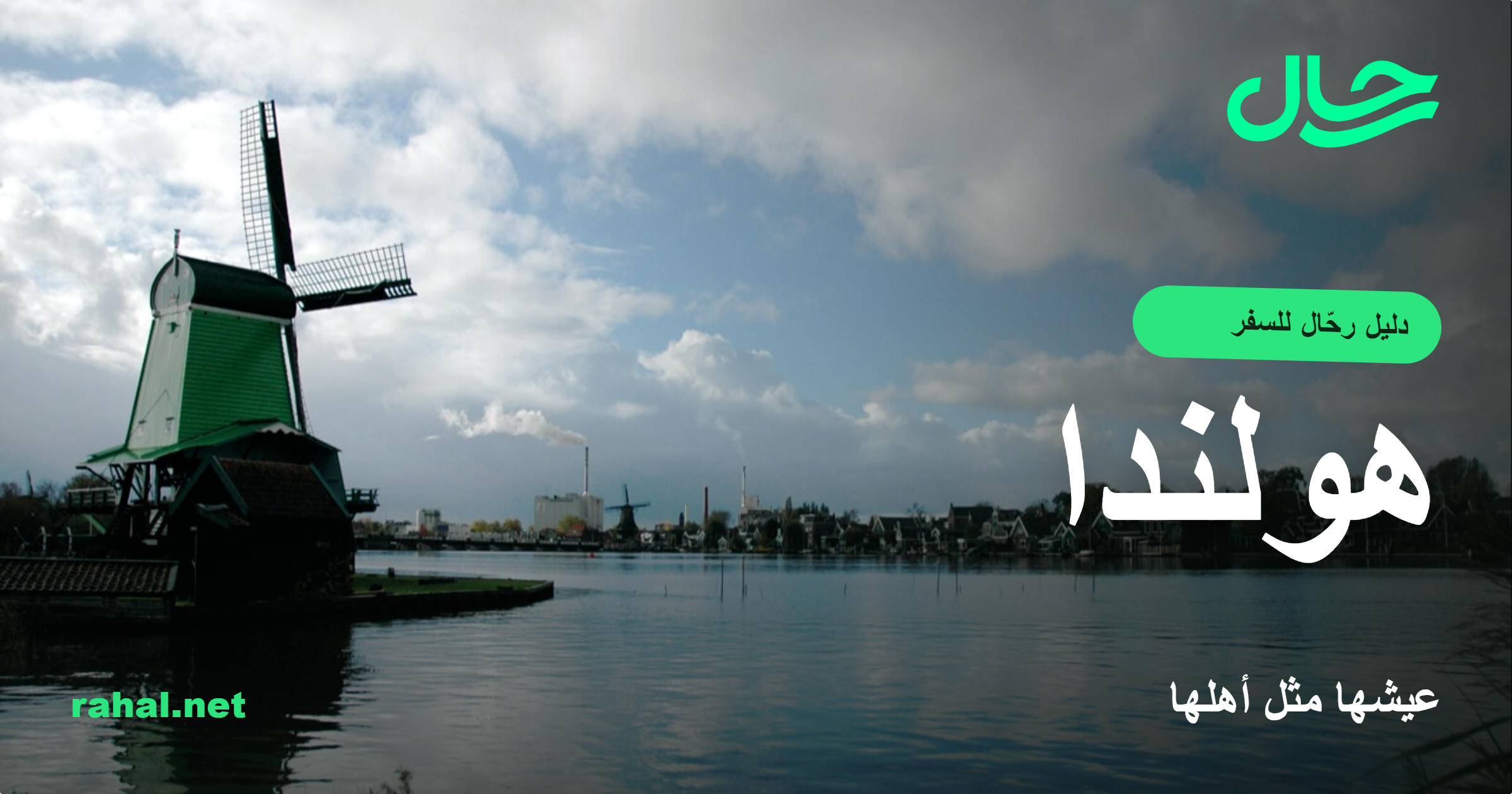
Netherlands Like a Local: The Real Travel Guide for Iraqis
The mistake every tourist visiting the Netherlands makes is photographing a windmill, buying a pair of wooden clogs, and going home with a tulip photo. Locals live the Netherlands in a completely different way: they cycle through heavy rain like it's a sunny day, sit on canal-side terraces until late at night, and know the best herring in the world isn't in Oslo — it's from a street cart in Amsterdam. This article isn't a list of landmarks. It's a guide to living.
Who lives there?
The Netherlands has around 17.9 million people in a relatively small area, making it one of the densest countries in the world. The median age is 43. Over 92% live in cities, and the density shows in everything: narrow streets, tall and narrow houses, and everyone carefully accounting for space.
The official language is Dutch, but the Dutch are among the most fluent English speakers in Europe. In practice, you can live and work in big cities entirely in English without issue. Homes also carry Turkish, Arab, Indonesian, and Surinamese heritage — the legacy of a colonial past that made the Netherlands diverse before "diversity" was fashionable.
Religion: over 50% don't identify with any religion, and the country is one of the world's earliest practically secular states. Muslims make up around 5% of the population, and the Moroccan and Turkish community has been an old, established part of the Dutch social fabric since the 1970s.
The daily rhythm: work starts early and ends early. "Work-life balance" is a real culture, not just talk — many employees work 4-day weeks. Friday afternoon means coffee with friends, and Sunday is for family and rest.
How much does daily life cost?
The average net salary in the Netherlands runs around €2,800–3,200/month for a full-time employee, but Amsterdam on average is noticeably more expensive than Germany.
Rent is the biggest and hardest expense: a one-bedroom apartment in central Amsterdam runs €1,300–1,800/month, dropping to €900–1,200 outside the center. A meal at a budget restaurant costs about €15, but food from a supermarket or street bakery gets you a meal for €5–7.
A monthly public transit pass (OV-chipkaart) within one city costs about €100–120. But real locals don't pay this — they just cycle, end of story. Home internet is good and fast at €35–50/month. Health insurance is mandatory for every resident and costs about €120–150/month.
Surprisingly cheap: fresh Dutch cheese (cheaper and better than any shop outside the Netherlands), fruit and vegetables at weekly markets. Expensive: rent, eating out, and public services compared to Germany.
(Numbeo Amsterdam 2026 figures: numbeo.com/cost-of-living/in/Amsterdam)
How do locals get around?
The bicycle isn't just transport in the Netherlands — it's national identity. The Netherlands has over 23 million bicycles for 18 million people — more than one bike per person. Children learn to ride a bike before they learn to read. Every city has a completely separate, fully safe network of bike lanes.
As a visitor, you can rent a bike through the OV-fiets app (available at train stations) for €4–6/day if you have a transit card, or from companies like Swapfiets or Donkey Republic for €10–15/day.
Public transport is excellent: trams, buses, and metro in big cities. Between cities, the train network (NS) connects all major cities easily: Amsterdam to Rotterdam takes 40 minutes, and Amsterdam to The Hague takes 50 minutes. Buy tickets through the NS app for cheaper prices than the station counters.
What confuses outsiders: the dedicated bike lane is separate from both the sidewalk and the street. Standing or walking on a bike lane is a serious mistake, and a bike will come at you faster than expected. Learn the difference between the three lanes from day one.
What do they eat, and when?
Dutch breakfast is simple and distinctive: white or brown bread with butter and cheese, Nutella, or "hagelslag" (chocolate sprinkles put on bread — a genuine source of national pride, not a joke). Coffee is black and strong. It's usually eaten at home.
Lunch is light for many Dutch people: a sandwich from home or a nearby bakery. Dinner is the main meal, eaten very early by families, between 6 and 7 pm. Restaurants operate from 6 to 10 pm.
Dishes you must try:
- Stroopwafel: a caramel-filled waffle disc between two thin layers, best eaten held over a hot cup of coffee so the caramel softens
- Haring (raw herring): a small fish with chopped onion and pickle, held by the tail and eaten. Not for the faint of heart, but locals love it
- Bitterballen: crispy fried balls with meat ragout and béchamel, the official pub-snack pairing for beer with friends
- Poffertjes: small puffy pancakes with butter and powdered sugar
- Dutch-Turkish kebab: the large Turkish community made the döner a staple, with quality not far off from Berlin's
A myth worth busting: that Dutch food is heavy and bland. True for traditional cuisine. But big Dutch cities are among the most diverse in Europe for Indonesian, Surinamese, Moroccan, and Turkish restaurants.
Worth remembering: the Albert Cuypmarkt market in Amsterdam (De Pijp neighborhood) is open every day Tuesday through Saturday — the longest street market in the Netherlands. Fresh cheese, herring, vegetables, and food from every culture. Tourists don't know about it; real Amsterdammers shop there weekly.
The unwritten rules
The Dutch are famous for "directness." They state their opinion without hedging and don't mean any offense by it. If you say something wrong, they'll correct it confidently. This isn't rudeness — it's culture. Learn to take it at face value.
Punctuality in the Netherlands is strikingly strict, even for social occasions. If you're invited to dinner at 7, being there at 7:05 is fine and needs no apology, but 20 minutes late without a prior call is considered unacceptable.
The Dutch split bills precisely. When you go out to a restaurant with Dutch friends, everyone pays their exact share. This isn't stinginess — it's equality. "Going Dutch" is an English phrase invented about them for exactly this reason.
Privacy is respected: don't ask a Dutch person about their salary or age at a first meeting. Curtains in Dutch homes are usually left open at night (an old 17th-century tradition meaning "I have nothing to hide"), but that's not an invitation to stare.
Where do locals live?
The Dutch have historically rented at a high rate despite rising purchase prices. Dutch houses are narrow and tall (3 to 4 floors, sometimes just 4 meters wide) due to a historical 17th-century tax based on frontage width.
In Amsterdam: locals live in Amsterdam Noord (north of the canal, reached by a free ferry), Amsterdam Zuid, De Pijp, and Oost. The historic center (Centrum) is for tourists and expensive hotels. To rent like a local, use Pararius or Funda for apartments, or Kamernet for shared rooms.
A cheaper, quieter alternative: Rotterdam, The Hague, and Utrecht are 20–30% cheaper than Amsterdam, with excellent train connections. Many Amsterdam employees live in neighboring cities and commute daily by train.
Rental rules: a deposit equal to two months' rent is typically required. The market in Amsterdam is highly competitive, and apartments get rented within days. For a visitor staying a month or two weeks, use Airbnb or Booking.com for short-term apartments.
🎵 Hear the Netherlands before you arrive
Dutch music isn't just windmills and tulips. Locals' everyday listening includes a long-running Amsterdam electronic music scene, Dutch hip-hop in the local accent, and music from the Moroccan and Turkish community that's become part of the country's sonic identity. Play the playlist while you pack.
For the Iraqi traveler 🇮🇶
Visa: Iraqi passport holders need a mandatory Schengen visa to enter the Netherlands. Apply through the Dutch Embassy in Baghdad or a VFS Global center. Standard requirements: a valid passport, confirmed bookings, travel insurance, and a 3-to-6-month bank statement. The application fee is €80. Processing takes 10–15 business days — apply at least a month ahead. Confirm information on the official Dutch Embassy website or VFS Global Iraq. (Verified: June 2026)
Flights: There are currently no direct flights between Iraq and the Netherlands. Turkish Airlines connects Baghdad and Erbil to Amsterdam (Schiphol) via Istanbul transit. Dutch airline KLM connects via flights from Gulf countries. FlyDubai and Gulf Air connect you to Amsterdam with one transit stop.
Cash and cards: The Netherlands is more digital than Germany — most shops accept cards, and some don't accept cash at all. Mastercard and Visa work well. A Wise or Revolut card is an excellent option with no transfer fees.
Halal food: Good availability, especially in Amsterdam, Rotterdam, and The Hague. The large Moroccan and Turkish community has made halal restaurants and butchers available in nearly every neighborhood. Use the Zabihah or HalalTrip app to find the nearest halal restaurant.
Community: The Arab and Iraqi community has a notable presence, especially in Amsterdam, The Hague, and Utrecht. Facebook groups like "Iraqis in the Netherlands" and "Arabs in the Netherlands" have up-to-date practical information from people actually living there.
The honest take
The Netherlands is excellent for anyone who loves clean air, green spaces, personal freedom, and cities designed for people, not cars. Iraqi travelers are usually surprised by the human warmth beneath the initial reserve, and by how established the Arab community is, making the place feel more familiar than expected.
What's genuinely hard: housing costs in Amsterdam are severe, and the weather can be unpleasant (near-constant light rain in winter). Prices overall run noticeably higher than Germany.
What gets overlooked: The Hague, the capital of international law and politics — calmer, more refined, and less crowded than Amsterdam, with endless museums and landmarks. And Delft, with its intact 17th-century houses, gives you more of a sense of the Dutch past than any museum could.
Who it suits: the Iraqi traveler who wants to experience real Europe, ride a bike (even for the first time), and learn how a society organizes itself through consensus rather than force. Not for someone who just wants to take photos and leave.
Bottom line: the Netherlands teaches you that freedom and order aren't opposites, and that the calmest-seeming people can be the warmest once you get to know them.
FAQ
Does an Iraqi passport need a visa for the Netherlands?Yes, a mandatory Schengen visa. Apply through the Dutch Embassy in Baghdad or a VFS Global center. Apply 4–6 weeks before your trip to avoid appointment pressure.
How much does a trip to the Netherlands cost for an Iraqi traveler?A budget traveler needs roughly €70–90 daily (hostel or shared room, bakery and supermarket food, public transport or a bike). At a mid-range hotel with restaurants, you'll need €150–200 daily. This excludes the flight, which ranges from $600–1,000 round-trip depending on season.
Is halal food available in the Netherlands?Yes, abundantly, especially in big cities. The Moroccan and Turkish community has been established for decades, making halal restaurants available in nearly every neighborhood. Use the Zabihah or HalalTrip app to find the nearest halal restaurant.
Is English enough to get by in the Netherlands?Yes, sufficient almost everywhere. The Dutch are among the most fluent English speakers in Europe. Even the elderly often speak good English. A few simple Dutch words are appreciated: Dank u wel (thank you), Alstublieft (here you go/please), Sorry (pronounced the same as in English and used often).
What's the best time to visit the Netherlands from Iraq?April and May: tulip season and the most beautiful weather, but the most tourist-crowded. June and July: excellent weather (18–22°C), long days, beer gardens and canal terraces at their peak. September and October: calmer, reasonable prices, autumn colors. Avoid November through March if you don't like cold and constant rain.
Do I need a car in the Netherlands?Never within cities. Bikes and public transport cover everything. Between cities, trains are excellent and faster than driving through traffic. A car is only useful if you want to explore the Dutch countryside and nature reserves.
Sources: Wikivoyage (CC BY-SA), CIA World Factbook (public domain), cost figures from Numbeo Amsterdam, visa information from VFS Global and official embassy websites. Last updated: June 2026.